Showing posts with label inspiration. Show all posts

Tuesday, 8 February 2011

War On Film: The American Civil War, by Ken Burns


Hailed everywhere as a masterpiece it took me long enough to watch a copy of Ken Burns' monumental documentary on the American Civil War. The approach is deceptively simple at first sight: instead of adopting an educational, omniscient tone in telling the history of the civil war Burns lets the protagonists of the story talk themselves, through voiceovers of letters, newspaper articles, diaries, and witness' accounts. The result - rather like in my favourite non-fiction book, Tristram Hunt's The English Civil War: At First Hand - feels much more authetic and direct to the audience, who feels included in the story, like standing at the centre of these events.

The accumulation of documents in the film is impressive: thousands of newspaper cuts, declarations, photographs, litographts, etc, are paraded in front of the viewer's eyes while the voices of familiar actors like Derek Jacobi, Julie Harris and Sam Waterson bring out the characters of hundreds of mayor and minor players in the combat. From Abraham Lincoln's views on what freedom means to the poignant letter of a soon-to-be-killed private to his wife, The American Civil War (1990) leaves nothing out, its fastidious obsession with detail make for 680 fascinating minutes. This is an in-depth work, not a general lecture of the subject. It's a balanced view, giving voice to both parts, the Union and the Confederates, with sympathy and rigor.

And it is a beautiful film as well. It becomes apparent in the first few minutes of the first episode ("The Cause", in which we see how the growning division on the slavery debate poised the North states against the South) that Ken Burns is filmmaker with a brilliant eye. Almost the whole documentary consists on archive material and yet Burns' (and his editor Paul Barnes) genius manages to make these still images and their rhythm seem absolutely stunning.

There's also the nice choice of David McCullough - one of the best and better respected writers of American history books - as the narrator. If the expression "a must see" still retained some meaning I'd say this is a must see.

Tuesday, 7 September 2010

Inspiration: Christopher Logue's translations of Homer


All Day Permanent Red [To Welcome Hector To His Death] 
by Christopher Logue

To welcome Hector to his death
God sent a rolling thunderclap across the sky
The city and the sea
      And momentarily—
The breezes playing with the sunlit dust—
On either slope a silence fell.

   Think of a raked sky-wide Venetian blind.
   Add the receding traction of its slats
   Of its slats of its slats as a hand draws it up.
   Hear the Greek army getting to its feet.
   
   Then of a stadium when many boards are raised
   And many faces change to one vast face.
   So, where there were so many masks,
   Now one Greek mask glittered from strip to ridge.
   Already swift
Boy Lutie took Prince Hector's nod
And fired his whip that right and left
Signalled to Ilium's wheels to fire their own,
And to the Wall-wide nodding plumes of Trojan infantry—

   Flutes!
   Flutes!
Screeching above the grave percussion of their feet
Shouting how they will force the savage Greeks
Back up the slope over the ridge, downplain
And slaughter them beside their ships—

   Add the reverberation of their hooves: and
   "Reach for your oars. . ."
T'lesspiax, his yard at 60°, sending it
Across the radiant air as Ilium swept
   Onto the strip
   Into the Greeks
   Over the venue where
Two hours ago all present prayed for peace.
   And carried Greece
Back up the slope that leads
   Via its ridge
   Onto the windy plain. 

Saturday, 24 July 2010

Inspiration: The Poetry of Richard Stanyhurst


Richard Stanihurst (or Stanyhurst) was an Irish poet and alchemist, 1547-1618.

He was a controversial figure - Catholic, born in Dublin but completed his studies in Oxford. He was a translator of Virgil. He worked for some time in the court of Philip II of Spain, studying alchemy in the laboratory in El Escorial.

As a poet he was sometimes critizised (even mocked) for his extravagant vocabulary and meter. But I picked up an anthology of 16th century at the Southbank's Poetry Library (wonderful place, visit it if you are in London) and I found his version of The Aeneid full of energy and strange and wondruous sounds.

I that in old season wyth reeds oten harmonye whistled
My rural sonnet; from forrest flitted (I) forced
Thee sulckīg swincker thee soyle, thoghe craggie, to sunder.
A labor and a trauaile too plow swayns hertelye welcoō.
Now māhod and garbroyls J chaunt, and martial horror.

There are not so many poets from Ireland that wrote in English and were accepted in the English literary circles at that time. I'm interested in the Irish experience in those centuries. None of the characters in my novel is Irish but when they arrive in Ireland they encounter a strange land that feels and sounds different to any other place these soldiers have been. I want to hear these sounds in the poetry of the 16th and 17th centuries, through the Irish poets.

Thursday, 17 June 2010

USEFUL & HELPFUL: Arms & Armour of the English Civil Wars


Arms and Armour of the English Civil Wars, by David Blackmore (Edited by Royal Armouries)

Though its writing style is a bit less than smooth, this book  has been indeed useful and helpful for two reasons: the detailed explanation (with figures) of the way firearms worked, with their different locks (match-lock, flint-lock, yadda yadda yadda) and the quoting of contemporary sources to illustrate the examples, which was a nice touch.

At 8.50 pounds second-hand at Waterstones in Bloomsbury it was a bit pricey, I admit, but the book is generous in images and it sure was inspirational, so I'm not really complaining.

Sunday, 9 May 2010

In search of Bunhill Fields and the perfect coffee


Bunhill Fields is the famous dissenters' cemetery near Old Street and Liverpool Street station in London. What neglect of me to have waited until now (and a Civil War reason for it) to visit. Specially since there lies William Blake, a particular favourite of mine since I was 13 or 14 and in one of my not-so-frequent visits to my father's family I chanced upon a volume of his poetry translated into Spanish. My grandmother gave me the book and I remember the excitement upon reading those lines for the first time. Blake was a revolutionary rebellious methaphysical malcontent, all of which appeal to me.


But this is not why we are here. Neither are the graves of Daniel Defoe or John Buynan, admired as they are. Why I'm here is because this ground is full of puritan's bones, directly or indirectly connected to those who made up a large bulk of the Parlamentarian faction during the English Civil War.

First of all, it is a wonderful, soothing place. I saw many people pass through its avenues (almost in the heart of the City, businessmen and women made their way across its green stillness) but very few paused to take in the calming shadows and earthy smell, the sounds of birds over the background of busy London traffic. There was a man walking his dog, well, more like playing with it extensively, it was a treat for the dog, he spent almost half hour there. I am suspicious of dogs in London parks (last year not once but twice I had my food stolen by dogs while I was picnic-ing in Battersea and Kensington) so I kept my distance. I spent a great deal of time with William Blake and was pleased to see traces of offerings upon and around his gravestone. Still going strong, old Blake.


THE SICK ROSE
      ROSE, thou art sick!
      The invisible worm,
      That flies in the night,
      In the howling storm,
       
      Has found out thy bed
      Of crimson joy;
      And his dark secret love
      Does thy life destroy.


Defoe has had not such luck. Better known by the general public, that's for sure (I cannot remember if I had to read Robinson Crusoe for school back in Spain but it's very possible that I did) but maybe he doesn't inspire that kind of dedication or committed fans. Other particular reason for my trip to Bunhill Fields was that Defoe has started to become a friend lately, after a second-hand battered copy of his Tour Through The Whole Islands of Britain made its way to my hands and now I try to use it for my own, much more modest, trips. He is good company in a journey.


Defoe might prove another Civil War connection yet, as I am waiting for Amazon to send me a copy of his Memoirs of a Cavalier which deals, as the title points out, with the sibject, as well as the Thirty Years War.

Lovely as walking around the burial grounds, and sitting on the benches and trying to remember all the words to "The Tyger" was, my final goal was somehow trampled. Wikipedia and the various websites I visited informed that two of the sons of Oliver Cromwell (including the one that succeeded him as Lord Protector, Richard) and his daughter's husband, Charles Fleetwood, high rank in Cromwell's army. I also had my sights on the graves of a couple of Quaker movement founders, George Fox and George Whitehead. This was all in vain. Said graves where in the part of the park not accesible to the public. Most graves were faded and bitten by time so it was impossible to spot any from a distance. Woe was me.


SIDE NOTE: I approached Bunhill Fields via starting at Bank station first. Why? Well, apart from books my other passion is coffee so I decided to treat myself to a breakfast at the Bank branch of Taylor Street Baristas - this cafe has a huge and completely justified fame. I was afraid of the hype but oh, no. Their flat white is an otherworldly experience. If you are ever in the City please do yourself a favour and visit.

A trip to Chichester cathedral


This past week I was in Chichester for a couple of hours for reasons that had nothing to do with the 17th century but I thought that I might as well keep up my search of all things related to the English Civil War. Or maybe this was an afterthought - for when I stepped inside Chichester's cathedral my only thoughts were for my love of these buildings and of poetry. Maybe one has to be a convinced atheist like me to be as much in love with cathedrals and churches as I am. Because when you take God out of the equation you are left alone with the truth of these beautiful, almost impossible places.


The building of the cathedral started on 1076, after the Council of London decided to move the cathedral from nearby Sesley to Chichester. Small for a cathedral, Chichester was when constructed a typical example of Norman style, but after the fire of 1187 Early Gothic elements were added. We are in Early Gothic country then and I must say that's where I feel most at ease. I like transition art forms and traces of more primitive styles to show up, specially in architecture. Chichester is a weird place, though, in that it mixes this very old enviroment with a lot of nods to modern - indeed modernist - art: there's a stunning tinted window by Marc Chagall, tapestries by John Piper and a painting by Graham Sutherland. All of this resting perfectly besides the Tudor painting of Kings and Queens of England and past bishops by Lambert Barnard that dominate the transepts. Wonderful incongruences. The most famous piece in the cathedral, though, is a medieval tomb for a knight and his wife. This particular sculpture depicts the couple holding hands, an unusual show of public affection for the times (and the status of the knight as well). Even if there has been some controversy around this tomb (is the hand-holding a later addition and not the astonishing medieval rarity all believed it to be?) one can't help to be a little in awe at the sight, specially if one keeps in mind (there's a reproduction by the side of the tomb, in case you forget) Philip Larkin's unbearably beautiful poem:

Side by side, their faces blurred,
The earl and countess lie in stone,
Their proper habits vaguely shown
As jointed armour, stiffened pleat,
And that faint hint of the absurd -
The little dogs under their feet.

Such plainness of the pre-baroque
Hardly involves the eye, until
It meets his left-hand gauntlet, still
Clasped empty in the other; and
One sees, with a sharp tender shock,
His hand withdrawn, holding her hand.

They would not think to lie so long.
Such faithfulness in effigy
Was just a detail friends would see:
A sculptor's sweet commissioned grace
Thrown off in helping to prolong
The Latin names around the base.

They would no guess how early in
Their supine stationary voyage
The air would change to soundless damage,
Turn the old tenantry away;
How soon succeeding eyes begin
To look, not read. Rigidly they

Persisted, linked, through lengths and breadths
Of time. Snow fell, undated. Light
Each summer thronged the grass. A bright
Litter of birdcalls strewed the same
Bone-littered ground. And up the paths
The endless altered people came,

Washing at their identity.
Now, helpless in the hollow of
An unarmorial age, a trough
Of smoke in slow suspended skeins
Above their scrap of history,
Only an attitude remains:

Time has transfigures them into
Untruth. The stone fidelity
They hardly meant has come to be
Their final blazon, and to prove
Our almost-instinct almost true:
What will survive of us is love.
  ’

(The tomb and the poem got me thinking a lot. I confess to being very shaken by it - I was fascinated by the fact that this very private gesture - the tomb was not meant to be seen by strangers, it was in the knight's house until it was destroyed, never meant to be displayed in a cathedral - ends up being spied on and reinterpreted by those who come upon it. It might as well have been all an invention: love is not there until we invent it. It got me thinking about private affections being transformed by and into stories. Yes, of course, it got me thinking about my novel.)

I would have been perfectly content with all this: it's a small, wonderful cathedral. But I also discovered some Civil War connections that sparked my imagination. 


When the Civil War broke out in 1942 Chichester declared for the King but the Parliament being strong in the South the army seiged the city. The cathedral itself was a dramatic site, ocuppied and plundered during the siege. (I already have Model Army soldiers sleeping in a desecrated church in the beginning scenes of my book but I wouldn't be surprised if Chichester cathedral ends up getting its way into my story as well somehow). The leader of the Parliamentarian forces in Chichester was William Cawley, son of a wealthy brewer and three times mayor of Chichester, John Cawley - pictured, remembered in this portrait in the cathedral. Fascinatingly so William Cawley was one of the men who signed Charles I's death sentence, and he had to flee England come the Restoration.

So, Civil War connections indeed. I got more than I bargained for. Thank you, Chichester.

Epilogue: Simon Armitage's new book came out while I was in Chichester, and since I always make a point of buying a book whenever I can if I visit a new city or town, and since I couldn't wait to read my favourite living poet's new volume, I was glad to pick up a copy:

Saturday, 10 April 2010

Read-a-thon


Today I'll be participating in Dewey's Read-a-thon. It's my first time doing this "event" so good luck to me. This is my stack:

Music and Silence by Rose Tremain.
The Earth Made of Glass by Robert Edric.
Tambourlaine Must Die by Louside Welsh.
Auriel Rising by Elizabeth Redfern.
Thurdsbitch by Alan Garner.
Three Power Plays by David Pinner. (theatre)
The Magic Apple Tree by Susanna Hill.
Unthinkable by Mark Sable. (graphic novel)


Thursday, 1 April 2010

A Visit To Turnham Green


These glriously sunny days are an invitation for a little trip around the city. All Civil War-related, of course.

Today I decided to venture a journey to the west in search of Turnham Green. It shames me to admit that I do not know the West of London very well, compared to other neighbourhood, which is ironic considering I live pretty much on the west. Research can get you out of your comfort zone and expeditions are literal as well as inner.

From UK Battlefields Resource Centre:

The battle of Turnham Green was fought on the 13th November 1642. Following the battle of Edgehill, and after taking Banbury and Oxford, the royalist army eventually advanced on London along the Thames valley. On 12th a royalist detachment attacked two parliamentarian regiments quartered in Brentford, which were covering the approach to London from the west. The royalists were victorious but their army was delayed by the parliamentarian resistance and halted, probably on Turnham Green at nightfall. This allowed the parliamentary field army and London militia to form-up on Turnham Green and Chiswick common field the next day.

Both armies appear to have deployed in traditional 17th century style with cavalry on the flanks and infantry in the centre. The parliamentarian line extended further than that of the King’s army on the northern side of the battlefield and the royalists deployed musketeers in the hedgerows there to counter this threat. These were driven out by parliamentarian troops, which then outflanked the royalists on that flank with a march to Acton. Despite this favourable position the parliamentarian commander, the earl of Essex, recalled this detachment due to fear over splitting his army and the battle settled into a stalemate. The royalist army was too small to force its way past the parliamentarian forces and, as night fell, the King had to withdraw.

Recriminations occurred on both sides following the battle. On the royalist side, there were some who judged the King had missed an opportunity to end the war, though in reality had he launched an attack on the parliamentarian lines his own army would probably have been defeated. Others on the parliamentarian side, who saw Turnham Green as a missed opportunity to defeat the royalist army, particularly following the successful outflanking manoeuvre, probably had more of a case.

Turnham Green is now largely encompassed by the urban development of Greater London. However there are limited areas which remain undeveloped – parts of Turnham Green and Acton Green, though now municipal parkland, provide a sense of the open ground, which extended as far south as Chiswick House in the 17th century.

Turnham Green is one of the few chances to visit Civil War battlefields inside London and since I'm short of cash to make trips to more glamurous locations like Edgehill at least for the moment, I took the bus towards Chiswick with high spirits and a copy of Eliot's The Wasteland in my bag, pen and paper, and my camera. (I always carry poetry with me, it's absolutely balsamic.)

Chsiwick itself is a tranquil and pretty part of the city; an explosion of green and things that scream "local goverment", with that feeling of tight community one finds in a village, not in a metropolis. It also looks tremendously fashionable and unaffordable.

Turnham Green turned out to be a small, flat, humble business of a park, not really atmospheric. This is the closest the Royalists came to London. I tried not to feel too esoteric about it - much as I like the idea of psychogeography I think of it as more of a poetic notion than real phenomena. But the sunlight was generous and the noises were few and I spent a nice morning sitting on benches reading and writing.


Then it was time to change scenery and make the most of a day in the West and in the 17th century but visiting another cultural, if less well-known, spot. After a long stroll along the Thames - strange, unfamiliar sights and moods, like those near the Steam Museum, and the treetops of Kew on the other side - I set off for Boston Manor Park.


The house in Boston Manor Park was built in 1623 and only converted into a house-museum in the early 20th century. The park itself is a mix of the mundane and the wild, with spots you'd find in Regent's or Hyde Park and then dark, untamed corners. (A man walking his dog passed my way and we exchange greetings - that doesn't happen in Spain, you don't exchange greetings at public parks, not in my experience anyway). The Lake was definitely a highlight. It felt refreshing under the shadow of the trees and once again I was reminded of my love of public parks.


I was excited to see the 17th century house - it looked interesting from the outside, not too grand - but alas, I had made a mistake checking the opening times and it was not open today. Oh well. The walk alone was worth it.


More info about the Battle of Turnham Green from the BBC.

Check out the website of the Friends of Boston Manor for history of the house and events.

Monday, 15 March 2010

Library loot.


- Lindsay Davis, Rebels and Traitors.
- Jean Plaidy, Saint Thomas' Eve. (my first Plaidy)
- Elizabeth Redfern, Auriel Rising.
- Richard Tames, Shakespeare's London.
- Malcolm Airs, Tudor & Jacobean country house.
- John Banville, Kepler.

Tuesday, 2 February 2010

INSPIRATION: Gerard ter Borch

A lady reading a letter.

Women writing a letter.

Woman drinking with sleeping soldier.


The Letter.

The Dispatch.

The Card Players.

A guard room.


Maybe it's an education thing but I have always associated the 17th century with what the Dutch paintings made of it. Those lights and shadows are still the first thing that comes to my mind when I think about the period - and it's a preconception I have to fight against when I'm trying to write about 17th century England.

Still, I find my particular fondness for Early Modern Dutch painting a great help when it comes to mood research; it's easier for me to slip into the lives and minds of these people when I look at these pictures. Rembrandt in particular is a great inspiration, with his poetry of shadows, and his resolve never to compromise.

The National Gallery - my favourite place whether I need to be inspired or simply kill some time - hosts some Gerard ter Borch paintings (most famously The Ratification of the Treaty of Munster). I wasn't familiar with the painter during my college years but lately I've been more and more interested in his work, specially his portrayals of soldiers during their waiting hours, in between battles.

When one is obssessed about a particular subject it's inevitable that in this single-mindness state one finds connections in everything. And I mean everything. But I think that in the case of Borch's paintings I am justified in finding quite appealing how many of his works seem to be Relevant To My Interests. Not only his painting about soldiers in calm moments -a third of my novel is composed of such scenes- but also the recurring theme of letter-writing and letter-reading. And then individual works that strike me and inspire me, such as The Card Players, and particularly the Woman Washing Her Hands, both postratying the same actions as those found in pivotal moments in my story. As I said, maybe obssession, but I like it. Seeing artists from that period take on the same elements as I am strugling with makes me feel in good company, with my feet on the ground.

Link: Gerard Terborch Online.

Woman reading a letter.

Woman washing her hands.

Lady reading a letter.

Sunday, 25 October 2009

Inspiration: The poetry of Andrew Marvell


Andrew Marvell is an intriguing one might even say mysterious figure, like some kind of 17th century's answer to Christopher Marlowe. He was a spy and politician, a womanizer, and the author of the famous poem "To My Coy Mistress". But he also witnessed the ups and lows of the English Civil War in first row. He was friend and colleague of John Milton, and together with him, he served under Oliver Cromwell as Latin secretary.

From Parangon Review: "Little is known about Marvell's early life. He was born in 1621 at Winestead, Holderness, where his father was rector. He was probably educated at Hull Grammar School, though there is no firm evidence for this. He went to Trinity College, Cambridge, as a sizar and graduated in 1638. He seems to have stayed at Trinity, but left before the opening of the Long Parliament in 1641. The next ten years of Marvell's life are obscure. He probably spent the years 1642-1646 abroad, but historians are only able to suggest his return to England by 1649 because of the publication of two of his poems in that year. In 1650 he was appointed by Thomas Fairfax as tutor to his daughter, Mary, and so Marvell returned to Yorkshire, spending two years at Nun Appleton. His association with Fairfax brought him into close contact with Cromwell and the political machinations of the Commonwealth. After years on the continent Marvell was a fine linguist and on 21 February 1653 Milton recommended that Marvell be appointed as his assistant (Milton was blind by this stage) in the secretaryship for foreign languages. He was also appointed by Cromwell as tutor to William Dutton, his ward.

Marvell's support for Oliver Cromwell was made most evident in his Horatian Ode upon Cromwell's return from Ireland written in the summer of 1650. However, it has been argued that one stanza of this poem indicates his Royalist rather than Cromwellian sympathies. And the fact that Marvell first became MP during the Interregnum but went on being an MP after the Restoration has kept the debate about his political sympathies alive. Marvell's letters as MP, written to the Hull Corporation, as well as to the masters of Trinity House Hull, survive in far greater number than his personal letters. However, as a source of information about Marvell's political and religious inclinations they are not very revealing. This has made historical research into Marvell's politics and religion difficult and the results are often controversial."


Horatian Ode upon Cromwell's Return from Ireland

The forward youth that would appear
Must now forsake his Muses dear,
Nor in the shadows sing
His numbers languishing.

'Tis time to leave the books in dust,
And oil th' unused armour's rust,
Removing from the wall
The corslet of the hall.

So restless Cromwell could not cease
In the inglorious arts of peace,
But through advent'rous war
Urged his active star:

And, like the three-forked lightning, first
Breaking the clouds where it was nursed,
Did thorough his own side
His fiery way divide.

For 'tis all one to courage high,
The emulous or enemy;
And with such, to enclose
Is more than to oppose.

Then burning through the air he went,
And palaces and temples rent;
And Caesar's head at last
Did through his laurels blast.

'Tis madness to resist or blame
The force of angry Heaven's flame;
And, if we would speak true,
Much to the man is due,

Who, from his private gardens, where
He lived reserved and austere,
As if his highest plot
To plant the bergamot,

Could by industrious valour climb
To ruin the great work of time,
And cast the Kingdom old
Into another mould.

Though Justice against Fate complain,
And plead the ancient Rights in vain:
But those do hold or break
As men are strong or weak.

Nature, that hateth emptiness,
Allows of penetration less;
And therefore must make room
Where greater spirits come.

What field of all the Civil Wars
Where his were not the deepest scars?
And Hampton shows what part
He had of wiser art;

Where, twining subtle fears with hope,
He wove a net of such a scope
That Charles himself might chase
To Carisbrook's narrow case;

That thence the Royal Actor borne
The tragic scaffold might adorn:
While round the armed bands
Did clap their bloody hands.

He nothing common did or mean
Upon that memorable scene,
But with his keener eye
The axe's edge did try;

Nor called the Gods with vulgar spite
To vindicate his helpless right;
But bowed his comely head
Down as upon a bed.

This was that memorable hour
Which first assured the forced pow'r.
So when they did design
The Capitol's first line,

A Bleeding Head, where they begun,
Did fright the architects to run;
And yet in that the State
Foresaw its happy fate.

And now the Irish are ashamed
To see themselves in one year tamed:
So much one man can do,
That does both act and know.

They can affirm his praises best,
And have, though overcome, confessed
How good he is, how just,
And fit for highest trust;

Nor yet grown stiffer with command,
But still in the Republic's hand:
How fit he is to sway
That can so well obey!

He to the Commons' feet presents
A kingdom for his first year's rents:
And, what he may, forbears
His fame to make it theirs:

And has his sword and spoils ungirt,
To lay them at the Public's skirt.
So when the falcon high
Falls heavy from the sky,

She, having killed, no more does search,
But on the next green bough to perch,
Where, when he first does lure,
The falcon'r has her sure.

What may not then our Isle presume
While victory his crest does plume!
What may not others fear
If thus he crown each year!

A Caesar he ere long to Gaul,
To Italy an Hannibal,
And to all states not free
Shall climacteric be.

The Pict no shelter now shall find
Within his parti-coloured mind;
But from this valour sad
Shrink underneath the plaid:

Happy if in the tufted brake
The English hunter him mistake,
Nor lay his hounds in near
The Caledonian deer.

But thou, the War's and Fortune's son,
March indefatigably on;
And for the last effect
Still keep thy sword erect:

Besides the force it has to fright
The spirits of the shady night,
The same arts that did gain
A pow'r must it maintain.

More: Andrew Marvell is the lead character of the wonderful novel The Green and the Gold by Christopher Peachment.

Friday, 4 September 2009

Prologue: How did I get here?

York, Sunday 30 August 2009


It's half past four in the morning and I'm in the train station at York, having just got off the coach from London. There are no lights in the sky and dawn won't break for another hour or two, I'm afraid. I'm tired, I'm cold and I'm slightly scared by being in a strange town in the pitch black night and with nobody in sight. There's nobody in the streets and on top of that it's Sunday. As a Spaniard with a very basic knowledge of British geography right now I could pinpoint York on a map just because I bought a slim tourist guide before I came here.

How did I get here?

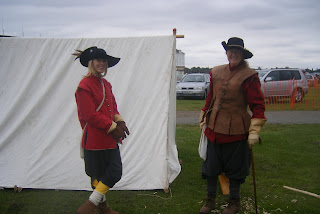
By becoming the kind of person who goes to English Civil War battles re-enactments. One year ago I would have been quick to mock the people who spend time in such events. And yet here I am, the last weekend of August, six hours of bus from London, cold and frightened in foreign and dark York, just to check out the annual re-enactment of the Marston Moors Battle, by The Sealed Knot Society.

Of course one year ago I couldn't even begin to predict that I would be writing a novel about the English Civil War myself.

After one hour or so hanging out in the train station - feeling slightly safe in the knowledge that there was a guard patrolling the whole place, but cursing that the cafes wouldn't open until 7 - I decided to venture into the city, suspecting the first lights. As it turns out it's a very beautiful town, and for a couple of hours I had it all to myself. That's the advantage of arriving in the middle of the night. The deserted city looked even more beutiful, ancient and haunting. I spent a great deal of time walking around the York Minster - appealingly gothic - before the cafes opened for a Full English breakfast.


I was trying to get myself all inspired and I had brought along some Ted Hughes volume for its sounds, reading to myself and wandering among the ruins of St.Mary's Abbey. I had always been curious about THE NORTH and since the main characters in my book it was decided would be Northerners, it was a good excercise in place-inspiration to breathe the air of these parts.


From my notebook of those hours (not even a day): "It feels a priviledge (& a small wonder) to be here and feel the air of the centuries, the birds in flight a rustle of feathers louder than the minster's bells. To be here and stare at the decay of things made by men, and their strange resilence too, for nothing is lost here, everything is skin-deep carved into these stones, the sorrows and the joy."


I walked and wandered, searching for clues on the city, hints of why I was there, why I had come to far and was I right in doing so?

Although the place was well signaled - or rather, I had printed out various maps, from Google Maps to the own Sealed Knot Society indications, I must have looked a bit ridiculous walking around checking all those papers - it took me quite a while to get to the site, the York racecourse. For one, I had no idea what an empty racecourse looked like, or what a british racecourse looked like, for that matter. But I turned left on a street and I found some open ground and as gloomy and gorgeous clouds filled the sky, I knew I was in the right place. The horizon started drawing tiny figures of people and tents and cars and there was smoke here and there.

And then I heard drums.

I had arrived.


Thanks to the running commentary (a modern-day solution to the confusion of watching the battles unfold) we could follow the various figures on the battlefield; we had one Cromwell, of course, and we even had a Thomas Fairfax.


"Here learn, ye mountains more unjust,
Which to abrupter greatness thrust,
That do, with your hook-shouldered height,
The earth deform, and heaven fright,
For whose excrescence, ill designed,
Nature must a new centre find,
Learn here those humble steps to tread,
Which to securer glory lead."
Andrew Marvell, UPON THE HILL AND GROVE AT BILLBOROW.


It was an eye-opening journey, but also a confirmation of faith. It was what I had hoped it would be, but in ways I never imagined it would be.