Showing posts with label poetry. Show all posts

Tuesday, 7 September 2010

Inspiration: Christopher Logue's translations of Homer


All Day Permanent Red [To Welcome Hector To His Death] 
by Christopher Logue

To welcome Hector to his death
God sent a rolling thunderclap across the sky
The city and the sea
      And momentarily—
The breezes playing with the sunlit dust—
On either slope a silence fell.

   Think of a raked sky-wide Venetian blind.
   Add the receding traction of its slats
   Of its slats of its slats as a hand draws it up.
   Hear the Greek army getting to its feet.
   
   Then of a stadium when many boards are raised
   And many faces change to one vast face.
   So, where there were so many masks,
   Now one Greek mask glittered from strip to ridge.
   Already swift
Boy Lutie took Prince Hector's nod
And fired his whip that right and left
Signalled to Ilium's wheels to fire their own,
And to the Wall-wide nodding plumes of Trojan infantry—

   Flutes!
   Flutes!
Screeching above the grave percussion of their feet
Shouting how they will force the savage Greeks
Back up the slope over the ridge, downplain
And slaughter them beside their ships—

   Add the reverberation of their hooves: and
   "Reach for your oars. . ."
T'lesspiax, his yard at 60°, sending it
Across the radiant air as Ilium swept
   Onto the strip
   Into the Greeks
   Over the venue where
Two hours ago all present prayed for peace.
   And carried Greece
Back up the slope that leads
   Via its ridge
   Onto the windy plain. 

Saturday, 24 July 2010

Inspiration: The Poetry of Richard Stanyhurst


Richard Stanihurst (or Stanyhurst) was an Irish poet and alchemist, 1547-1618.

He was a controversial figure - Catholic, born in Dublin but completed his studies in Oxford. He was a translator of Virgil. He worked for some time in the court of Philip II of Spain, studying alchemy in the laboratory in El Escorial.

As a poet he was sometimes critizised (even mocked) for his extravagant vocabulary and meter. But I picked up an anthology of 16th century at the Southbank's Poetry Library (wonderful place, visit it if you are in London) and I found his version of The Aeneid full of energy and strange and wondruous sounds.

I that in old season wyth reeds oten harmonye whistled
My rural sonnet; from forrest flitted (I) forced
Thee sulckīg swincker thee soyle, thoghe craggie, to sunder.
A labor and a trauaile too plow swayns hertelye welcoō.
Now māhod and garbroyls J chaunt, and martial horror.

There are not so many poets from Ireland that wrote in English and were accepted in the English literary circles at that time. I'm interested in the Irish experience in those centuries. None of the characters in my novel is Irish but when they arrive in Ireland they encounter a strange land that feels and sounds different to any other place these soldiers have been. I want to hear these sounds in the poetry of the 16th and 17th centuries, through the Irish poets.

Sunday, 9 May 2010

A trip to Chichester cathedral


This past week I was in Chichester for a couple of hours for reasons that had nothing to do with the 17th century but I thought that I might as well keep up my search of all things related to the English Civil War. Or maybe this was an afterthought - for when I stepped inside Chichester's cathedral my only thoughts were for my love of these buildings and of poetry. Maybe one has to be a convinced atheist like me to be as much in love with cathedrals and churches as I am. Because when you take God out of the equation you are left alone with the truth of these beautiful, almost impossible places.


The building of the cathedral started on 1076, after the Council of London decided to move the cathedral from nearby Sesley to Chichester. Small for a cathedral, Chichester was when constructed a typical example of Norman style, but after the fire of 1187 Early Gothic elements were added. We are in Early Gothic country then and I must say that's where I feel most at ease. I like transition art forms and traces of more primitive styles to show up, specially in architecture. Chichester is a weird place, though, in that it mixes this very old enviroment with a lot of nods to modern - indeed modernist - art: there's a stunning tinted window by Marc Chagall, tapestries by John Piper and a painting by Graham Sutherland. All of this resting perfectly besides the Tudor painting of Kings and Queens of England and past bishops by Lambert Barnard that dominate the transepts. Wonderful incongruences. The most famous piece in the cathedral, though, is a medieval tomb for a knight and his wife. This particular sculpture depicts the couple holding hands, an unusual show of public affection for the times (and the status of the knight as well). Even if there has been some controversy around this tomb (is the hand-holding a later addition and not the astonishing medieval rarity all believed it to be?) one can't help to be a little in awe at the sight, specially if one keeps in mind (there's a reproduction by the side of the tomb, in case you forget) Philip Larkin's unbearably beautiful poem:

Side by side, their faces blurred,
The earl and countess lie in stone,
Their proper habits vaguely shown
As jointed armour, stiffened pleat,
And that faint hint of the absurd -
The little dogs under their feet.

Such plainness of the pre-baroque
Hardly involves the eye, until
It meets his left-hand gauntlet, still
Clasped empty in the other; and
One sees, with a sharp tender shock,
His hand withdrawn, holding her hand.

They would not think to lie so long.
Such faithfulness in effigy
Was just a detail friends would see:
A sculptor's sweet commissioned grace
Thrown off in helping to prolong
The Latin names around the base.

They would no guess how early in
Their supine stationary voyage
The air would change to soundless damage,
Turn the old tenantry away;
How soon succeeding eyes begin
To look, not read. Rigidly they

Persisted, linked, through lengths and breadths
Of time. Snow fell, undated. Light
Each summer thronged the grass. A bright
Litter of birdcalls strewed the same
Bone-littered ground. And up the paths
The endless altered people came,

Washing at their identity.
Now, helpless in the hollow of
An unarmorial age, a trough
Of smoke in slow suspended skeins
Above their scrap of history,
Only an attitude remains:

Time has transfigures them into
Untruth. The stone fidelity
They hardly meant has come to be
Their final blazon, and to prove
Our almost-instinct almost true:
What will survive of us is love.
  ’

(The tomb and the poem got me thinking a lot. I confess to being very shaken by it - I was fascinated by the fact that this very private gesture - the tomb was not meant to be seen by strangers, it was in the knight's house until it was destroyed, never meant to be displayed in a cathedral - ends up being spied on and reinterpreted by those who come upon it. It might as well have been all an invention: love is not there until we invent it. It got me thinking about private affections being transformed by and into stories. Yes, of course, it got me thinking about my novel.)

I would have been perfectly content with all this: it's a small, wonderful cathedral. But I also discovered some Civil War connections that sparked my imagination. 


When the Civil War broke out in 1942 Chichester declared for the King but the Parliament being strong in the South the army seiged the city. The cathedral itself was a dramatic site, ocuppied and plundered during the siege. (I already have Model Army soldiers sleeping in a desecrated church in the beginning scenes of my book but I wouldn't be surprised if Chichester cathedral ends up getting its way into my story as well somehow). The leader of the Parliamentarian forces in Chichester was William Cawley, son of a wealthy brewer and three times mayor of Chichester, John Cawley - pictured, remembered in this portrait in the cathedral. Fascinatingly so William Cawley was one of the men who signed Charles I's death sentence, and he had to flee England come the Restoration.

So, Civil War connections indeed. I got more than I bargained for. Thank you, Chichester.

Epilogue: Simon Armitage's new book came out while I was in Chichester, and since I always make a point of buying a book whenever I can if I visit a new city or town, and since I couldn't wait to read my favourite living poet's new volume, I was glad to pick up a copy:

Friday, 23 April 2010

Simon Armitage @ Swedenborg House


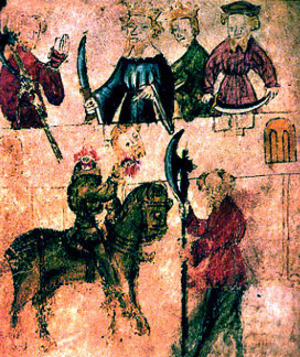
Last night I went to a reading-plus-talk about the translation of the epic Old English poem Sir Gawain and the Green Knight, by Simon Armitage. For various reasons (you can check the poem of the day at his website if you want to find them) Simon Armitage is my favourite living poet so I could not past up this opportinity to see him read his work live for the first time. I knew nothing about the Swedenborg Society when I arrived at their House in Bloomsbury, nothing about Emanuel Swedenborg, inventor and philosopher of the 18th century. But it was a prettily put event; Armitage not only read from his world-famous translation of Gawain and answered the audience questions but he also talked about the themes in the poem and showed us a bit of the documentary he made for BBC4 about it.

Gawain is a gorgeous poem and Armitage's translation (my introduction to the poem, actually, a couple of years ago) keeps the music of the original Middle-English language, it's a piece full of alliterations and wonderful noise. Armitage insisted in the connection of the poem with nature, the way the language and landscape are entwined. This is particularly interesting for a poet like Armitage, self-confessed Ted Hughes admirer and a worthy heir of England's best nature poet. It is also the most interesting aspect of the translation for me, as well; how the landscape needs to influence the language of your work, specially if you are dealing with a historical period (Gawain was probably written around 1400) where people were more in contact with raw nature on a daily basis than we are now in our technological and man-made society. The writing has to reflect the sound and rhythm of the story's landscapes and that's what Armitage excels at in this translation. That and a very peculiar sense of humour, perfectly fit to the playful original. Armitage confessed to being drawn to the topography of the poem because it's very likely that the original author came from the same area as Armitage comes from, a frontier-land in the south Pennines - somewhere between Cheshire, Derbyshire, Staffordshire and Lancashire.

Gawain is a great mystery - written by a someone contemporary of Chaucer but with a very different language, a whole other dialect indeed, the poem catches the excitement of the English language starting to come together, come alive. We don't know who wrote Sir Gawain and the Green Knight and we might never find out. Simon Armitage, at least, declared his hopes that we should never resolve the riddle of this anonymous author. He'd like to live with the mystery intact.

This is one of my favourite passages, when the Green Knight gets his head chopped off at the Court of King Arthur, but remains alive and well nonetheless:

In the standing position he prepared to be struck,
bent forward, revealing a flash of green flesh
as he heaped his hair to the crown of his head,
the nape of his neck now naked and ready.
Gawain grips the axe and heaves it heavenwards,
plants his left foot firmly on the floor in front,
then swings it swiftly towards the bare skin.
The cleanness of the strike cleaved the spinal cord
and parted the fat and the flesh so far
that that bright steel blade took a bite from the floor.
The handsome head tumbles onto the earth
and the king's men kick it as it clatters past.
Blood gutters brightly against his green gown,
yet the man doesn't shudder or stagger or sink
but trudges towards them on those tree-trunk legs
and rummages around, reaches at their feet
and cops hold of his head and hoists it high,
and strides to his steed, snatches the bridle,
steps into the stirrup and swings into the saddle
still gripping his head by a handful of hair.
Then he settles himself in his seat with the ease
of a man unmarked, never mind being minus
his head!
And when he wheeled about
his bloody neck still bled.
His point was proved. The court
was deadened now with dread.


Sunday, 25 October 2009

Inspiration: The poetry of Andrew Marvell


Andrew Marvell is an intriguing one might even say mysterious figure, like some kind of 17th century's answer to Christopher Marlowe. He was a spy and politician, a womanizer, and the author of the famous poem "To My Coy Mistress". But he also witnessed the ups and lows of the English Civil War in first row. He was friend and colleague of John Milton, and together with him, he served under Oliver Cromwell as Latin secretary.

From Parangon Review: "Little is known about Marvell's early life. He was born in 1621 at Winestead, Holderness, where his father was rector. He was probably educated at Hull Grammar School, though there is no firm evidence for this. He went to Trinity College, Cambridge, as a sizar and graduated in 1638. He seems to have stayed at Trinity, but left before the opening of the Long Parliament in 1641. The next ten years of Marvell's life are obscure. He probably spent the years 1642-1646 abroad, but historians are only able to suggest his return to England by 1649 because of the publication of two of his poems in that year. In 1650 he was appointed by Thomas Fairfax as tutor to his daughter, Mary, and so Marvell returned to Yorkshire, spending two years at Nun Appleton. His association with Fairfax brought him into close contact with Cromwell and the political machinations of the Commonwealth. After years on the continent Marvell was a fine linguist and on 21 February 1653 Milton recommended that Marvell be appointed as his assistant (Milton was blind by this stage) in the secretaryship for foreign languages. He was also appointed by Cromwell as tutor to William Dutton, his ward.

Marvell's support for Oliver Cromwell was made most evident in his Horatian Ode upon Cromwell's return from Ireland written in the summer of 1650. However, it has been argued that one stanza of this poem indicates his Royalist rather than Cromwellian sympathies. And the fact that Marvell first became MP during the Interregnum but went on being an MP after the Restoration has kept the debate about his political sympathies alive. Marvell's letters as MP, written to the Hull Corporation, as well as to the masters of Trinity House Hull, survive in far greater number than his personal letters. However, as a source of information about Marvell's political and religious inclinations they are not very revealing. This has made historical research into Marvell's politics and religion difficult and the results are often controversial."


Horatian Ode upon Cromwell's Return from Ireland

The forward youth that would appear
Must now forsake his Muses dear,
Nor in the shadows sing
His numbers languishing.

'Tis time to leave the books in dust,
And oil th' unused armour's rust,
Removing from the wall
The corslet of the hall.

So restless Cromwell could not cease
In the inglorious arts of peace,
But through advent'rous war
Urged his active star:

And, like the three-forked lightning, first
Breaking the clouds where it was nursed,
Did thorough his own side
His fiery way divide.

For 'tis all one to courage high,
The emulous or enemy;
And with such, to enclose
Is more than to oppose.

Then burning through the air he went,
And palaces and temples rent;
And Caesar's head at last
Did through his laurels blast.

'Tis madness to resist or blame
The force of angry Heaven's flame;
And, if we would speak true,
Much to the man is due,

Who, from his private gardens, where
He lived reserved and austere,
As if his highest plot
To plant the bergamot,

Could by industrious valour climb
To ruin the great work of time,
And cast the Kingdom old
Into another mould.

Though Justice against Fate complain,
And plead the ancient Rights in vain:
But those do hold or break
As men are strong or weak.

Nature, that hateth emptiness,
Allows of penetration less;
And therefore must make room
Where greater spirits come.

What field of all the Civil Wars
Where his were not the deepest scars?
And Hampton shows what part
He had of wiser art;

Where, twining subtle fears with hope,
He wove a net of such a scope
That Charles himself might chase
To Carisbrook's narrow case;

That thence the Royal Actor borne
The tragic scaffold might adorn:
While round the armed bands
Did clap their bloody hands.

He nothing common did or mean
Upon that memorable scene,
But with his keener eye
The axe's edge did try;

Nor called the Gods with vulgar spite
To vindicate his helpless right;
But bowed his comely head
Down as upon a bed.

This was that memorable hour
Which first assured the forced pow'r.
So when they did design
The Capitol's first line,

A Bleeding Head, where they begun,
Did fright the architects to run;
And yet in that the State
Foresaw its happy fate.

And now the Irish are ashamed
To see themselves in one year tamed:
So much one man can do,
That does both act and know.

They can affirm his praises best,
And have, though overcome, confessed
How good he is, how just,
And fit for highest trust;

Nor yet grown stiffer with command,
But still in the Republic's hand:
How fit he is to sway
That can so well obey!

He to the Commons' feet presents
A kingdom for his first year's rents:
And, what he may, forbears
His fame to make it theirs:

And has his sword and spoils ungirt,
To lay them at the Public's skirt.
So when the falcon high
Falls heavy from the sky,

She, having killed, no more does search,
But on the next green bough to perch,
Where, when he first does lure,
The falcon'r has her sure.

What may not then our Isle presume
While victory his crest does plume!
What may not others fear
If thus he crown each year!

A Caesar he ere long to Gaul,
To Italy an Hannibal,
And to all states not free
Shall climacteric be.

The Pict no shelter now shall find
Within his parti-coloured mind;
But from this valour sad
Shrink underneath the plaid:

Happy if in the tufted brake
The English hunter him mistake,
Nor lay his hounds in near
The Caledonian deer.

But thou, the War's and Fortune's son,
March indefatigably on;
And for the last effect
Still keep thy sword erect:

Besides the force it has to fright
The spirits of the shady night,
The same arts that did gain
A pow'r must it maintain.

More: Andrew Marvell is the lead character of the wonderful novel The Green and the Gold by Christopher Peachment.